


Description
Ontario warehouse managers often mix pallet jacks and forklifts on the same floor. This guide explains when each machine is the right call for capacity, lift height, aisle space, training, and cost.
Pallet Jack vs. Forklift in Ontario: Which Machine Does Your Warehouse Actually Need?
TLDR
A pallet jack moves a pallet a few inches off the floor across a short, flat path. A forklift lifts, stacks, and travels with a rated mast. If your GTA dock only needs to pull pallets off a trailer and stage them at ground level, a manual or electric pallet jack is usually enough. If you put product into rack, load trucks from the floor, or handle mixed outdoor work, you need a forklift. Ontario employers still train operators on powered equipment under the Occupational Health and Safety Act. Alteon Equipment in Mississauga can help you rent or buy the mix that matches the job, not the catalogue.
Table of Contents
- What Each Machine Actually Does
- Capacity, Lift Height, and Aisle Reality
- When a Pallet Jack Is the Right Call
- When You Need a Forklift
- Manual vs. Electric Pallet Jacks
- Ontario Training and Compliance
- Cost: Buy, Rent, or Mix the Fleet
- A Simple Decision Checklist for GTA Sites
- How Alteon Equipment Helps
What Each Machine Actually Does
A pallet jack (pallet truck) slides forks into a pallet, raises it just enough to clear the floor, and moves it. Standard units lift about 3 to 8 inches. They shine on level concrete in receiving, staging, and retail back rooms.
A forklift uses a mast (or boom, on other classes) to raise a load to rack height, truck-bed height, or higher. It also travels farther, handles heavier picks, and, depending on class, works outdoors. For a full class breakdown, see Alteon's guide to forklift types.
Both move pallets. Only one of them stacks.
BigRentz notes that OSHA groups powered pallet jacks and forklifts as powered industrial trucks in the United States. Ontario treats powered lift trucks as a Ministry of Labour priority as well. The Ontario Guideline for the Safe Operation and Maintenance of Powered Lift Trucks exists because these machines cause serious injuries when training and maintenance slip.
Capacity, Lift Height, and Aisle Reality
Typical ranges from industry comparisons such as DOZR and BigRentz:
| Need | Pallet jack | Forklift |
|---|---|---|
| Floor travel of pallets | Yes | Yes |
| Lift height | Usually 3-8 inches (stackers go higher) | Rack, truck, and high stacking |
| Common capacity | About 2,000-5,500 lb on standard units; some heavy-duty jacks go higher | Common warehouse trucks from about 5,000 lb up; special units go much higher |
| Aisle fit | Tight stockrooms and trailer interiors | Needs designed aisle width and turning radius |
| Surface | Flat indoor floors | Indoor, dock, and (by class) outdoor |
If the pick is ground-to-ground, a jack wins on cost and space. If the pick is ground-to-beam, a jack is the wrong tool.
GTA warehouses in Mississauga, Brampton, Vaughan, and Etobicoke often run both: jacks at the dock, sit-down or reach trucks in the rack. Mixing them is normal. Using a sit-down truck for every 20-foot dock shuffle is not.
When a Pallet Jack Is the Right Call
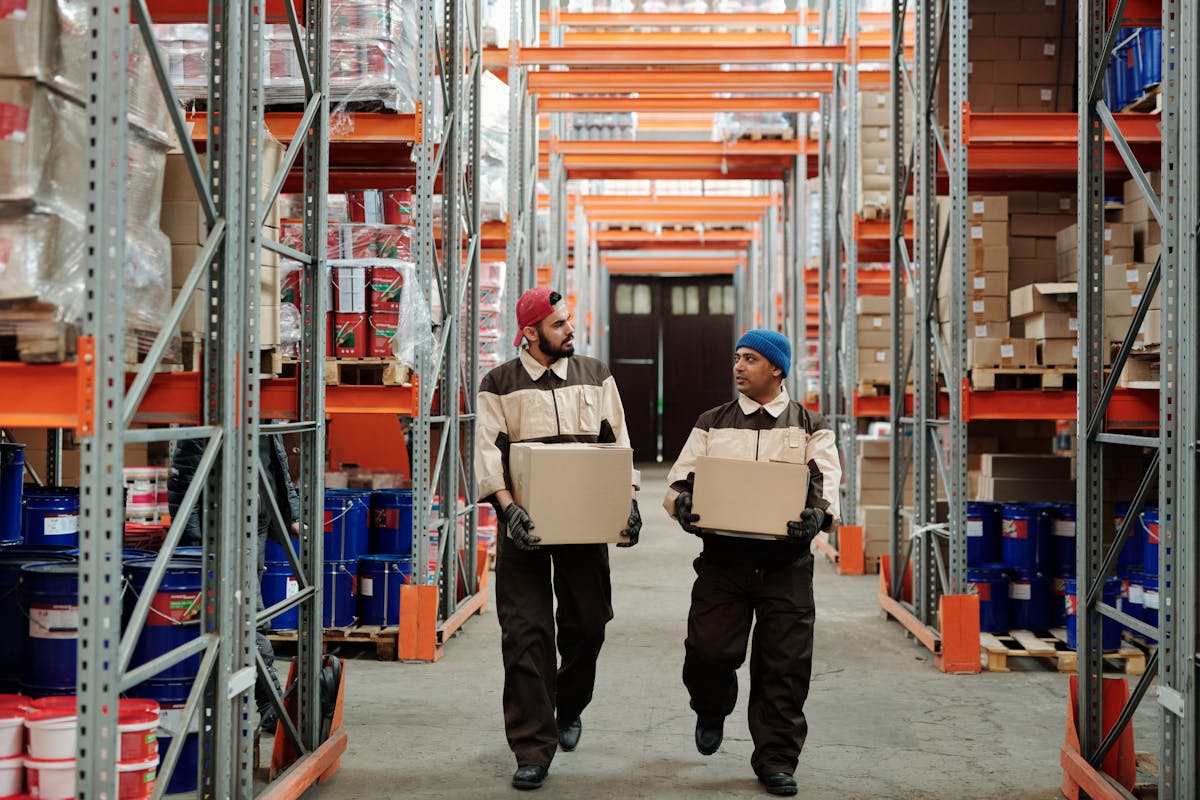
Pallet jacks win on short, flat dock-to-staging runs where loads stay at floor level and aisles are tight.
Use a pallet jack when:
- Pallets stay on the floor or on a low staging lane
- Distances are short (trailer to staging, staging to pack)
- Aisles or trailer interiors are too tight for a counterbalance truck
- You want lower capital cost and simpler daily checks
- Operators already work the floor and you do not need mast work
Retail, grocery, light manufacturing, and 3PL inbound all live here. A walkie electric jack still counts as powered equipment. It is not a toy.
Do not use a jack to "almost" stack. Walkie stackers exist for low-level putaway. They are a different machine than a standard pallet jack.
When You Need a Forklift

Once loads leave the floor for racking, dock height, or longer travel, a rated mast truck is the safe call.
You need a forklift when you:
- Place pallets into selective rack, drive-in, or mezzanine
- Load or unload from dock height without a leveler, or work mixed dock and yard
- Move loads beyond what a jack can safely travel
- Need attachments (sideshift, clamp, fork positioner)
- Work outdoors or on imperfect surfaces (then class and tire type matter)
For indoor rack vs. dock work, reach truck vs. counterbalance is the next decision after "jack vs. truck." For Q4 volume, peak-season forklift rental in the GTA covers short-term trucks without buying a unit that sits in January.
Electric vs. propane still matters once you choose a forklift. See electric vs. propane forklifts.
Manual vs. Electric Pallet Jacks
Manual (hand pallet truck): Pump to lift, walk to move. Best for light volume, short runs, and backup units. Lower purchase cost. Operator fatigue shows up on long dock days and heavier pallets.
Electric walkie: Battery drive and lift. Better for all-day inbound, longer warehouse runs, and heavier standard pallets. Needs charging discipline and trained operators.
Rider / end-rider: For long hauls in large DCs. Faster travel. Needs more floor space, more training, and tighter traffic rules.
If your Mississauga site runs 40+ pallets per shift across a long building, a manual jack is a bottleneck. If you move eight pallets a day in a back room, buying a rider is waste.
Ontario Training and Compliance
Ontario employers must take every precaution reasonable for worker protection under OHSA. The Ministry's powered lift truck guideline covers operator competence, supervision, and maintenance. Powered pallet jacks are not exempt from a serious training program.
Practical expectations for GTA sites:
- Train on the specific class of equipment the person will use (walkie vs. sit-down vs. reach)
- Keep written records
- Inspect equipment before each shift
- Maintain trucks so they can lift rated load
- Separate pedestrian walkways from equipment traffic
U.S. OSHA rules are not Ontario law. Do not copy a U.S. wallet-card course and assume it satisfies a Ministry inspector. Use Ontario-competent instruction and site-specific evaluation.
Manual pallet jacks still need instruction on load stability, trailer creep, and crushed-foot hazards. Powered units need more.
For forklift-side inspection and operator rules already on this site, see forklift inspection requirements in Ontario and forklift operator certification in Ontario.
Cost: Buy, Rent, or Mix the Fleet
Pallet jacks cost less to buy, rent, and maintain. Forklifts cost more because they do more work and carry more risk.
BigRentz published example U.S. monthly rental ranges of roughly $204–$542 for a pallet jack versus about $1,200–$3,475 for a basic forklift. Treat those as order-of-magnitude, not an Ontario quote. Local rates depend on class, shift use, delivery, and season.
A sensible GTA mix:
- Own or long-term rent the jacks you use every day
- Own or lease the forklifts that run full shifts
- Short-term rent extra forklifts for peak inbound, shutdowns, and repairs
Do not rent a 5,000 lb sit-down truck because a jack "feels slow" if the real problem is charging, aisle congestion, or untrained staff. Fix the process first.
For local rental context, see forklift rental in Mississauga.
A Simple Decision Checklist for GTA Sites
- Does the load leave the floor by more than a few inches? If yes, forklift or stacker. If no, jack.
- What is the heaviest pallet, including wrap and dunnage? Match the nameplate, not a guess.
- How far does it travel? Short dock path: jack. Cross-building or yard: forklift (or rider jack indoors).
- What is the aisle and trailer width? Tight: jack or narrow-aisle truck. Open dock: either.
- Indoor only, or yard as well? Outdoor work points to a forklift class, not a warehouse jack.
- Peak vs. baseline volume? Peak often means extra jacks plus one rental forklift, not a permanent extra sit-down.
Write those answers down before you call a dealer. It shortens the quote and reduces the chance you over-buy.
How Alteon Equipment Helps
Alteon Equipment is a forklift dealer in Mississauga, Ontario, with a second location in Arlington, Texas. We sell, rent, and service equipment for warehouse, manufacturing, and logistics teams across the GTA.
If you are unsure whether the next unit should be a walkie jack, a sit-down truck, or a reach truck, send us the heaviest pallet, the highest pick, and a photo or sketch of the aisle. We will tell you which machine fits, and whether rental or purchase makes more sense for the next 90 days.
Call +1 905 238 8881 or email Sales@alteonequipment.com.
No equipment on this floor should be a compromise between "too small to stack" and "too large for the trailer." Get the mix right once, then keep it maintained.

Post a Comment